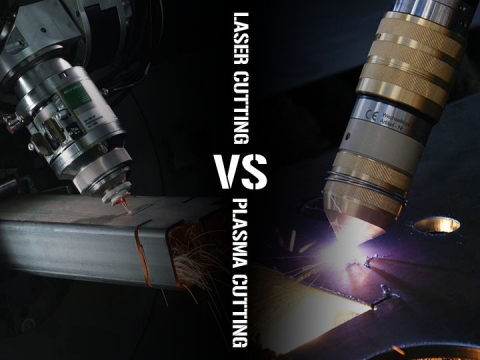
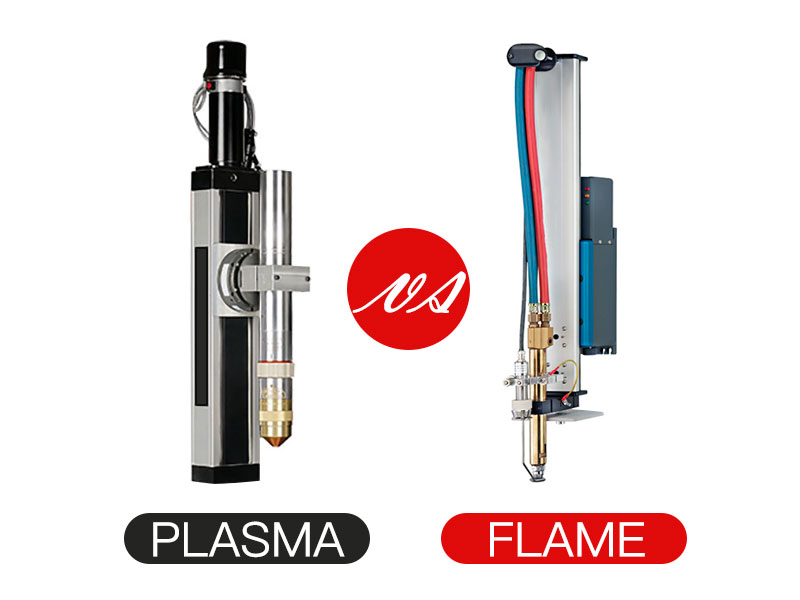
相比于 等離子切割系統(tǒng),火焰切割系統(tǒng)或氧燃料切割炬是厚度超過 1 英寸的低碳鋼的實(shí)用選擇,而等離子割炬則適用于較薄的材料,無論是黑色金屬還是有色金屬。
To start, let's wrap our heads around how does the 2 systems work.
等離子切割機(jī)如何工作?
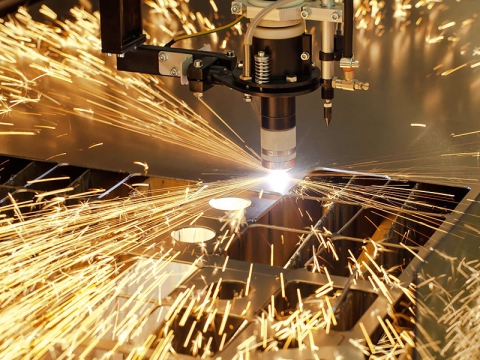
等離子切割機(jī)使用壓縮空氣、氮?dú)狻⒀鯕獾葰怏w,并通過該氣體發(fā)出電弧。這會(huì)將氣體變成等離子,然后快速?zèng)_破金屬,以高速切割金屬。
That high speed plasma is called the “plasma jet”, and it almost instantly heats the metal to around 30,000-40,000 °F and at extremely high speeds like 20,000 feet per 2nd – this is basically why plasma cutter is so fast. That's a pretty insane temperature.
本質(zhì)上,等離子切割只是以可控的方式焚化材料。
此外,還有一層氣簾保護(hù)切割區(qū)域,提高切割質(zhì)量。它有助于使切割更直、更薄。
火焰切割炬如何工作?
If you think that a flame cutting torch simply melts the material away, that's only half the answer.
A flame cutting torch works by adding a blast of oxygen to the flame which oxidizes the steel and turns it into slag. Essentially, it's a chemical reaction between the oxygen and the steel. The heat just makes this reaction happen really fast.
可以將其想象成一種超快速且可控的生銹。
火焰將鋼預(yù)熱至約 1800 華氏度,加壓氧氣會(huì)氧化并炸掉材料。
因此,從本質(zhì)上講,您可以切割的低碳鋼的厚度等于您可以加熱和用加壓氧氣流噴射的量。使用較大的設(shè)備,切割深度可以相當(dāng)深 - 您可以切割厚度超過一英尺的鋼材。只是需要一段時(shí)間。
等離子切割系統(tǒng) VS 火焰切割系統(tǒng)
| 等離子切割系統(tǒng) | 火焰切割系統(tǒng) |
| 切割鋼、鐵、不銹鋼、鋁、黃銅以及任何導(dǎo)電材料 | 能夠切割低碳鋼和鐵,對(duì)其他薄材料也有一定的加工能力 |
| 很少能夠切割厚度超過 2 英寸的鋼材,但對(duì)于大型機(jī)器來說,最佳切割厚度通常為 3/4 英寸及以下 | 可以切割極厚的金屬——通常厚度超過 12 英寸——具體取決于噴嘴的尺寸 |
| 窄切口 | 切口更寬 |
| 購(gòu)買更昂貴的系統(tǒng) | 更經(jīng)濟(jì)實(shí)惠的系統(tǒng)購(gòu)買 |
| 切割更干凈,通常只需要用鋼絲刷修整邊緣 | 切割較粗糙,需要更多清理,可能需要用磨床 |
| 切割速度非常快 | 切割速度較慢 |
| 可切割材料的厚度由機(jī)器的尺寸決定。 | 更換噴嘴以適應(yīng)不同厚度的材料 |
讓我們比較一下等離子切割系統(tǒng)和火焰切割系統(tǒng)的區(qū)別:
應(yīng)用
等離子切割在這方面確實(shí)大放異彩——由于等離子只是帶電氣體,等離子切割機(jī)基本上可以切割任何導(dǎo)電材料。鋁、鋼、不銹鋼、黃銅、銅,只要你說得出來,等離子切割機(jī)都能快速完成。
For flame cutting torches, the answer is a little more complicated. They're intended for mild steel, but there's an asterisk on that statement.
If you've played around with one yourself, you'll know that you actually can cut through thinner aluminum and stainless, as well as other materials. But the cuts will be ugly and messy. Here's why:
The process is intended to oxidize the metal. Stainless and aluminum don't really oxidize much. So instead of turning the metal into slag, you're actually just melting a gap in the material, and the force of the flame is pushing it out. You can't cut these materials when they're thick, this more so happens for sheet metal.
So the technical answer is that you can get through these other materials if they're thin, but it's gonna be ugly. Also, the surrounding metal will be really affected by the heat, which will mean that you can get some crazy warping (like with stainless) or a massive heat affected zone (like with alloy steel). Basically, it's just mild steel that's recommended for cutting torches.
厚度
Oxyfuel torches eat thick steel for breakfast. If you're trying to get through a 4″ thick steel axle, then the cutting torch is your tool.
The really heavy duty ones can cut through as much as 4 feet of solid steel. Honestly, it's pretty unlikely that you'll encounter this on a regular basis, but you never know, right? The part to remember is that you can slice through an engine block, as long as it's made of iron and not aluminum.
不過,對(duì)于大多數(shù)設(shè)備來說,如果你有一個(gè)大的割炬噴嘴,那么最大厚度可以達(dá)到一英尺。噴嘴越小,切口越薄,切割的材料也越薄。
Plasma torches don't cut nearly as thick. The really heavy duty ones can get up to about 2-3/4″ thick, but it's not too likely that you'll get your hands on one of those. The standard industrial ones cut more so around 1″ thick material, and the 業(yè)余愛好machines tend to max out at about 1/4″ 或 3/8″。
速度
Again, plasma shines. Since it's working with such insane heat, it's a really fast cutter. Apples to apples, you'll never keep up to plasma with a cutting torch.
便攜性
火焰切割系統(tǒng)絕對(duì)是最便攜的,因?yàn)樗梢越壴诳ㄜ嚿希谔锏刂醒肭懈钔侠瓩C(jī)。你可以把它帶到任何可以攜帶的地方。
The plasma cutter is (generally) a smaller unit, so it's easy to carry, but you need to be able to plug it in. The smaller 業(yè)余愛好units are usually around 20-30 pounds. If you're working in shops, it's not a problem, but if you're working on a farm, it can be annoying.
耗材
Both systems have consumables – the tips will wear out and there will be small replacement parts. This isn't a major expense, though.
不過,這是我更喜歡等離子的地方:對(duì)于氧燃料,你需要重新填充氣瓶。對(duì)于等離子,你通常只需要壓縮空氣。
從技術(shù)上講,等離子體會(huì)消耗相當(dāng)多的電能
可選項(xiàng)
火焰噴燈使用起來非常簡(jiǎn)單,只需選擇適合該工作的噴嘴尺寸即可。唯一值得確保的另一件事是安裝了回火防止器,這樣就不會(huì)發(fā)生爆炸。
There are a few terms worth knowing, though, when you're looking at buying a plasma torch. Here's an overview and an explanation of what they mean.
多功能
This is a loaded question – both systems have things that the other can't do.
For oxy acetylene, different torches (welding, cutting or rosebud) can let you weld, heat, hardface, cut, solder, braze, blend and gouge. For cutting, you're mainly limited to mild steel, but you can weld most metals with it.
對(duì)于等離子切割機(jī),通常可以找到三合一小型設(shè)備,可以切割、TIG 和電弧焊接。除此之外,等離子切割機(jī)還可用于切割。
引弧
This is basically a little wire that keeps the plasma running when it's not close to the workpiece.
It's practical for applications like working with expanded metal or mesh. It will keep the machine running consistently for interrupted cutting.
If you're just wanting to get some work in the garage done, you won't really need this, and you won't see much benefit if you're only cutting sheet metal or slicing apart a car. If you're doing a lot of mesh-type work, though, it does speed up the process.
高頻
This is referring to what's used to start the plasma torch, and it's similar with a welder. Basically, a high frequency, high voltage current is powered through the torch which makes it easier to start cutting.
This makes the piercing point smaller, cleaner, and easier, and it's handy for thicker materials.
Generally speaking, you don't need this for 業(yè)余愛好machines that are used for thin sheet metal. If anything, a good practice is to pierce the material slightly off the line where you want to cut, then sweep the plasma on to the cut line
您應(yīng)該選擇哪種金屬切割系統(tǒng)?
Here's when you should get a flame cutting torch:
1. You're working with mild steel.
2. 您使用重型設(shè)備工作。
3. 您想切割重型車軸和大塊鋼材。
4. 你喜歡每種工具都至少擁有一個(gè)。
5. 多功能性很重要——您不僅要切割,還要焊接和加熱金屬。
6. You don't need to cut sheet metal and plates quickly, but you want to have it as an option.
7. You'd like something that you can take out to the middle of a field to work with – electricity not required.
Here's when you should get a plasma cutter:
1. 您想將卡車車架切成碎片。
2. You're interested in fabrication.
3. 你喜歡每種工具都至少擁有一個(gè)。
4. 您希望能夠快速切割金屬板和板材。
5. You're an artist and make sheet metal sculptures.
6. You're working with a wide variety of materials.
7. 你主要關(guān)注的是切割,多功能性是次要的。
8. Mobility isn't too important, you'll be working primarily in shops.